
For years, I have stood firmly behind a simple belief as a superintendent: Students must be present to win.
We built systems around that belief. Attendance ladders. Incentives. Brain-based structures that rewarded consistency—10 days, 20 days, 30 days, and ultimately perfect attendance. We paired it with a “Home Court Advantage” rooted in safety, support, and belonging. And it worked… at least on paper. Attendance improved. Growth metrics ticked upward.
But something was missing.
Students were there—but they weren’t fully present.
That realization crystallized for me this last week at the 2026 NSBA National Conference in San Antonio. What I experienced wasn’t just professional development—it was a digital and social epiphany.
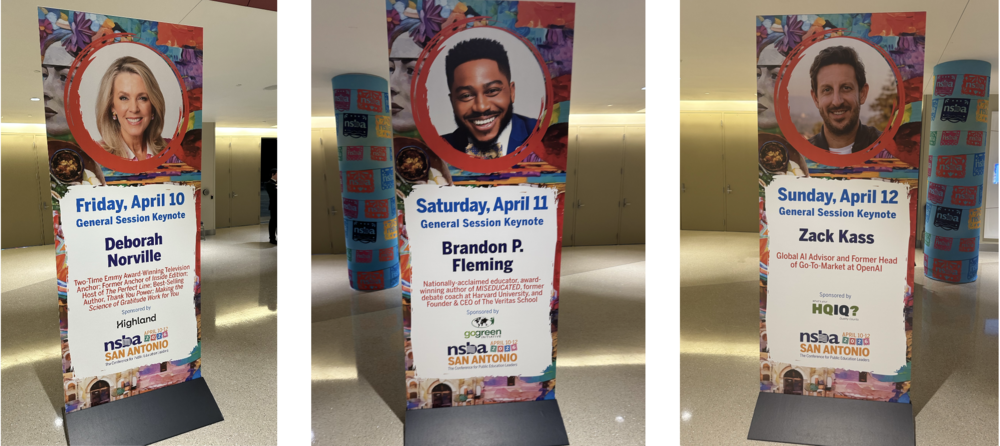
Keynote Speaker on April 10, Deborah Norville reminded me that respect and gratitude are not soft skills—they are foundational human needs. In a world increasingly driven by speed and surface-level interaction, these values are eroding, and with them, our sense of connection. We need R-E-S-P-E-C-T to be taught at the forefront of all instructional concepts.
Keynote Speaker on April 11, Brandon P. Fleming reinforced something we often overlook in education: learning is emotional before it is intellectual. His 70/30 framework—70% emotion (pathos), 30% intellect (logos)—hit hard. If our instruction lacks relevance and emotional connection, we are asking students to store information their brains are not wired to retain. Without meaning, there is no memory. Without connection, there is no resilience. He asks the question: What if the performance gap of students has less to do with information and more to do with experience and culture? This lends truth to the theory that a culturally relevant environment activates the brain, potential and performance in ways that might otherwise remain untapped. In other words, for those children underperforming, it has more to do with their environment than their ability.
And then came the jolt.
Keynote Speaker on April 12, Zack Kass challenged us with an uncomfortable truth: technology—particularly unregulated screen time—may be reshaping not just how students learn, but who they are becoming. When he described cell phones as a “demon” holding hostage our values, relationships, and ability to choose, it forced me to confront something deeper. The issue is not just access to technology—it is the cost of unchecked immersion.
We are witnessing a quiet erosion of presence.
Our students are navigating identity displacement, fractured attention, and a digital landscape where truth is increasingly difficult to discern. They are connected to everything—and yet, often grounded in nothing.
So where does that leave us as educators?
It means attendance is no longer enough.
We must redefine what it means to be present in our schools.
Presence is:
Being emotionally engaged, not just physically seated
Feeling seen, valued, and respected
Connecting learning to purpose and identity
Building relationships that anchor students in a rapidly shifting world
It also means we must confront hard realities:
Outdated facilities that fail to inspire belonging
Discipline challenges rooted in disconnection, not defiance
Instruction that struggles to compete with the immediacy of digital stimuli
But more importantly, it calls us to action.
We need systems that:
Prioritize relationships as the foundation of learning
Integrate relevance so students see themselves in their education
Teach discernment in a world flooded with information
Cultivate gratitude, respect, and values as daily practices—not occasional lessons
This is not about rejecting technology. It’s about reclaiming humanity within it.
My epiphany is this:
We cannot solve today’s educational challenges with yesterday’s definitions of success.
“Must Be Present to Win” still matters—but now, presence must go deeper.
Because in the end, it’s not just about getting students into the building.
It’s about bringing them fully back into themselves.
BE BRAVE! & BE PRESENT!
Go Braves!
@SchoolBoards, @NSBAPublicEd, @nsbacube